

Liquid Damage Repair
Spilled a drink, dropped it down the loo, caught in the rain? We open it, clean the board under a microscope and tell you what can be saved.
What to Do Right Now
Take a breath, then move fast. The first minutes often decide whether this is a clean or a write-off.
Switch It Off
Do not turn it on to check whether it still works.
Why
Water conducts. With the power on, electricity finds paths across the board it was never meant to take - that is a short circuit, and it burns components in seconds. It also speeds up corrosion.
Take the Battery Out
Only if it slides out. Do not force a glued-in one.
Why
A battery that is still connected keeps the board live even when the screen is dark. Built-in batteries are held down with adhesive and sit next to parts that puncture easily, so those come out on the bench, not at the kitchen table.
SIM, Cards, Case Out
Tip the water out gently. No shaking, no blowing.
Why
Shaking and blowing push liquid further in, past seals and under shielding where it is hardest to reach. Tipping lets gravity take out what it can without spreading the rest.
Bring It Straight In
Skip the rice. Walk into Wimbledon or post it.
Why
Rice pulls a little moisture out of the air around the device. It cannot touch the corrosive residue already sitting on the board, and rice dust gets into ports and speakers. Meanwhile the corrosion carries on.
Never Use Heat
No hair dryer, no radiator, no oven, no direct sun. Heat warps parts and lifts glued joints. Drying has to be slow and cool, which is why it happens in a chamber.
What You Are Actually Paying For
Not a rinse. Hours of bench work that end in a real answer.
Stripped Down and Mapped
Taken apart completely and photographed, so we see how far it travelled.
Every Joint Checked
The board goes under a microscope. Corrosion at this scale is invisible by eye.
Residue Removed, Board Tested
Cleaned in an ultrasonic bath, then tested point by point.
A Verdict
What is wrong, what fixing it takes, whether it is worth doing.

What the Fee Does Not Promise
It buys the work and the verdict, and it stops the corrosion spreading. It is not a guarantee the device can be repaired, and it applies either way.
Why Every Hour Matters
Corrosion starts almost the moment water reaches the board - rust, essentially, metal reacting with water and air. It runs faster if the device is still switched on.
Not All Liquids Are Equal
What went in changes how fast the damage moves and how it has to be treated.
Clean Water
Does the least chemical harm, but it still carries current and still starts corrosion. Caught early, a clean often restores everything.
Lower riskTea, Coffee, Soft Drinks
Acids and sugars. They eat metal faster than water does and leave a sticky film that traps moisture against the board.
Moderate riskSalt Water
The worst of the everyday ones. Salt carries current extremely well and attacks metal within minutes, across the whole board.
Higher riskCleaners and Solvents
These dissolve plastics and coatings outright. Some of what they do cannot be undone at any price.
Severe risk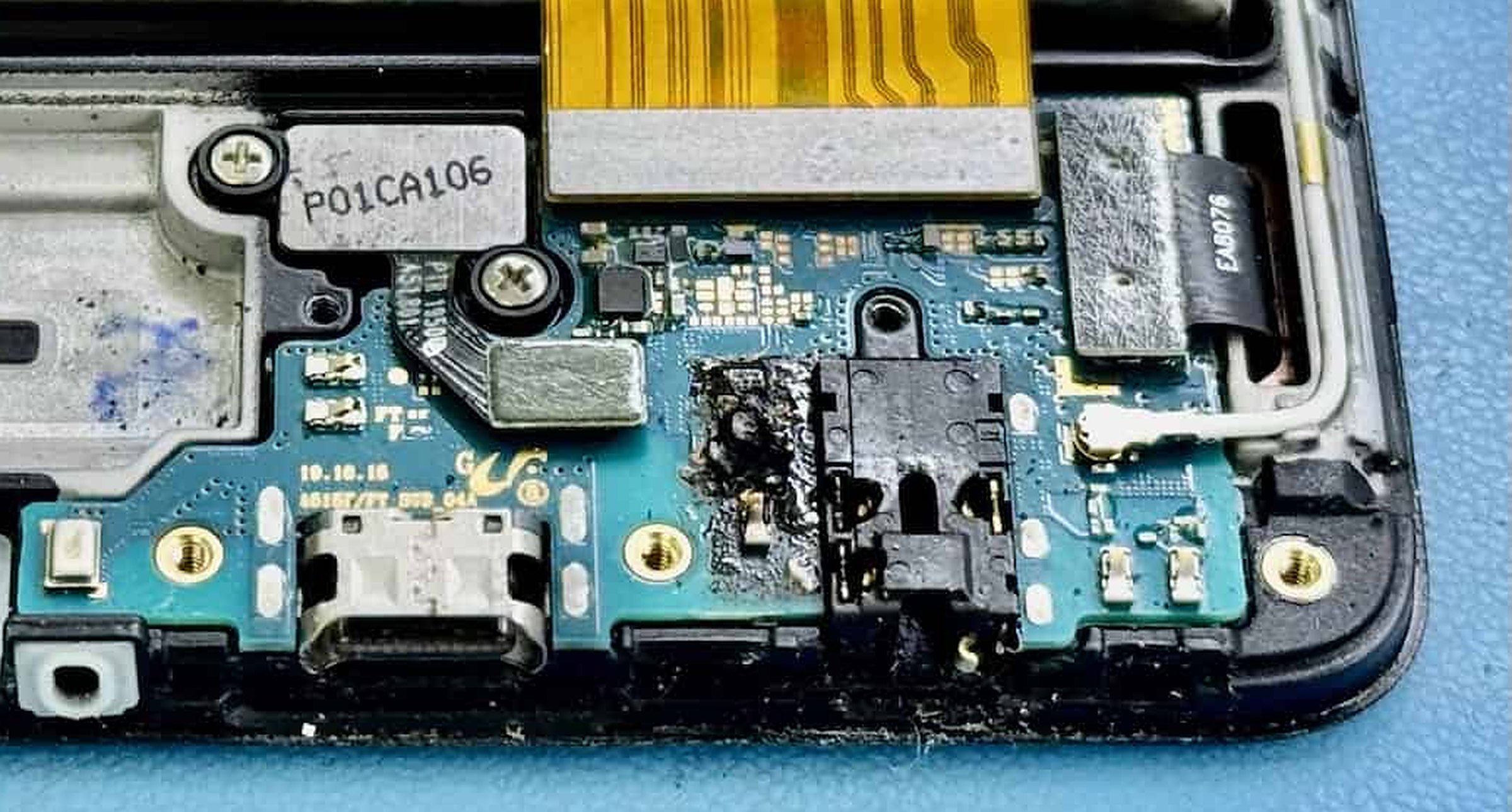
What We Might Find Inside
Liquid damage is unpredictable. The assessment tells us which of these four you are looking at, and we say which one plainly.
- Often A Clean and a CheckResidue off, board tests clear, device works. No parts. Common when it arrives early.
- Sometimes A Part or TwoA corroded charging port, battery or speaker gets replaced. Straightforward once the board is clean - quoted before we do it.
- Sometimes Board-Level RepairA corroded copper track or a failed chip needs microsoldering - repair of parts smaller than a grain of rice.
- Occasionally Beyond RepairDeep corrosion cannot be undone, and mainboards are rarely sold as spares. We can usually still recover the data - and a board that cannot be saved can still donate the parts that survived.
What Happens on the Bench
Six steps, always the same order.
Apart and Photographed
Fully stripped and photographed under the microscope before anyone touches it.
Ultrasonic Clean
A bath vibrating thousands of times a second lifts residue from every gap.
Dried Slowly and Cool
In a controlled chamber, not with heat. Leftover moisture restarts corrosion.
Inspected and Metered
Back under magnification, then a meter across the board hunting shorts.
Repaired or Replaced
Corroded parts off with hot air. Broken copper tracks bridged under the microscope.
Back Together and Tested
Charging, sound, cameras and wireless - all checked before it returns.


The Device, or What Is on It?
Tell us which matters more - it changes where the hours go.
The Device
You want it back in your pocket, working.
- Every system the device needs
- Damaged parts replaced, not nursed
- Every function tested afterwards
The Photos
You want what is on it, even if the device does not survive.
- Temporary repairs to reach the files
- Reading the storage chip directly
- Storage circuits treated first
Say So Up Front
If there are photos on there you have not backed up, say so before we start. We can often manage both. More on data recovery.
Cleaning and Diagnosis Fee
Paid up front, whatever the outcome. Any repair it turns up is quoted separately, and you decide before we start.
| Device | From |
|---|---|
| Phones |
£59
|
| Tablets and drones |
£75
|
| Laptops |
£90
|
| Microsoft Surface |
£100
|
- Full teardown and inspection
- Ultrasonic clean of the board
- Controlled drying
- Assessment under the microscope
- Full function testing
- A written diagnosis
On laptops and Surface, the keyboard and screen assembly are cleaned too.
Before You Book
These are starting prices. MacBooks and any laptop with a glued-in screen take longer to open safely, so they cost a little more. We confirm the exact figure before we start.
The fee applies whatever happens. It pays for the cleaning, the microscope assessment and for stopping the damage getting worse - including when the device turns out to be beyond repair.
Repairs are separate. If a part or board work is needed you get a price first and decide then. Because the assessment shows the full extent of the damage, that price is worked out rather than guessed.
Liquid Damage FAQ
Can You Guarantee My Device Will Be Fixed?
No shop honestly can - liquid damage is unpredictable by nature. What we can do is give it the best chance, quickly, and tell you where yours stands. Odds run from very good (clean water, caught early) to poor (salt water or cleaning products).
It Still Turns On. Does It Really Need Cleaning?
Yes. The corrosion carries on whether the device seems fine or not, and parts commonly fail days or weeks later. Cleaning removes the residue that causes those delayed failures.
Will Rice Not Do the Same Job?
No. Rice takes a little moisture out of the air. It does nothing about the residue already on the board, and rice dust ends up in ports and speakers. An ultrasonic bath is what actually gets the deposits off.
How Long Does It Take?
Cleaning and assessment is 1-3 working days if you bring it in, 2-5 if you post it. If parts are needed the whole repair usually runs 3-7 days depending on availability. Liquid damage jumps the queue because it is time-sensitive.
What if You Cannot Fix It?
The fee still applies - the assessment work has been done either way. But we can usually still get the data off, and the cleaning stops things deteriorating if you want to try recovery elsewhere.
Can You Recover Data if It Will Not Turn On?
Often, yes. Sometimes we restore just enough function to pull the files off; in bad cases we read the storage chip directly. Data recovery succeeds more often than full device recovery does.
Should I Try to Dry It Myself First?
No. Home drying cannot remove the residue and risks heat damage. The single most useful thing you can do is get it to us while the damage is still reversible.
Do You Help With Insurance Claims?
We give you a detailed report and documentation to send to your insurer. We cannot promise their decision - policies differ - but you will have what the claim needs.
Related Repair Services
Do Not Wait It Out
The sooner it reaches us, the more there is to save. Book the cleaning and diagnosis and we will tell you exactly what it needs.