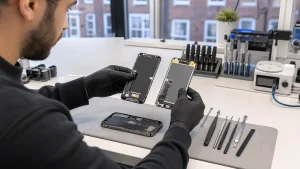
A repair technician’s honest breakdown of what it actually costs to own a foldable phone — and why that matters more than ever with the iPhone Fold on the horizon.
Foldable phones are the most exciting thing to happen to smartphones in years. A device that unfolds into a small tablet, then folds back into your pocket — it feels like the future. Samsung has been selling them since 2019. Huawei, Google, Motorola, and OnePlus have all joined in. And now Apple is widely expected to launch its first foldable iPhone later this year, with analysts predicting a price tag north of £1,600.
But here’s something the launch events, YouTube reviews, and carrier promotions rarely mention: what happens when something goes wrong.
We’ve been repairing phones for over 11 years. More than 220,000 devices have come through our workshop — cracked screens, dead batteries, liquid damage, motherboard failures. We’ve seen every kind of broken phone imaginable. And foldable phones are in a category of their own. Not because they break more often (though some do), but because when they break, fixing them is harder, more expensive, and sometimes impossible in ways that would surprise most people.
This isn’t a hit piece on foldable phones. Some of them are genuinely brilliant devices. This is the honest breakdown we’d give a friend who’s thinking about buying one.
How Foldable Phones Are Different — Mechanically
A regular smartphone is essentially a sealed glass-and-metal sandwich. The screen is bonded to the frame. There’s one battery, one motherboard, and a relatively straightforward internal layout. After over a decade of evolution, the repair industry knows these devices inside out.
A foldable phone is a fundamentally different machine. Instead of rigid glass, the main display uses ultra-thin flexible OLED — a screen that literally bends. To make that possible, manufacturers use a combination of ultra-thin glass layers (reported as thin as ~30 micrometres in some designs) and polyimide film. This makes the display functional, but also significantly more fragile than a standard phone screen.
Then there’s the hinge. This is the mechanical heart of any foldable — a precision-engineered mechanism with dozens of moving parts that must fold perfectly tens of thousands of times while keeping dust out and the screen aligned. Samsung’s latest models are tested to 200,000 folds, which sounds impressive until you do the maths — at 100-200 opens per day (typical to heavy usage), that’s roughly 3 to 5 years before the hinge reaches its tested limit.
Inside, the phone splits into two halves connected by flexible cables running through the hinge. Most foldables use dual batteries (one in each half), which complicates both the design and any future repairs.
The Real Cost of Foldable Phone Repairs in the UK
Let’s talk numbers, because this is where it gets uncomfortable.
Samsung Galaxy Z Fold inner screen replacement — the foldable display — costs between £499 and £599 at specialist UK repair shops using genuine Samsung Service Pack displays. Trade pricing we’ve seen for the Z Fold 7’s inner screen component can exceed £640. The outer display is an additional £129 to £169 depending on the model. If both screens are damaged, you’re looking at £650 to £750 or more just for the screens.
For comparison, replacing the screen on a Galaxy S25 Ultra costs roughly £259 to £399 in the UK, depending on whether you go through Samsung or an independent repairer.
The Galaxy Z Flip isn’t much better. Inner screen replacement runs £299 to £349. And remember — these are prices from specialist shops that actually stock the parts. Many UK repair shops simply refuse to touch foldable phones at all.
Here’s a quick comparison of what screen repairs actually cost across different phone types in the UK:
| Device | Screen Replacement (UK) | iFixit Repairability |
|---|---|---|
| iPhone 15 Pro Max | £280–£389 | 7/10 |
| Samsung Galaxy S25 Ultra | £259–£399 | 5/10 |
| Google Pixel 9 Pro | £229–£279 | 5/10 |
| Samsung Galaxy Z Fold 7 | £539+ (inner screen only) | 3/10 |
| Samsung Galaxy Z Flip 7 | £299+ (inner screen only) | ~3/10 |
| Motorola Razr (original) | Parts barely available | 1/10 |
These aren’t typos. The original Motorola Razr scored 1 out of 10 for repairability. The latest Samsung Galaxy Z Fold 7 scores just 3 out of 10. For context, a standard iPhone 15 scores 7 out of 10 and the Galaxy S25 Ultra scores 5 — foldables are in a different league entirely.
And screen damage is just one scenario. Here’s what else can go wrong.
The Five Failure Points Unique to Foldable Phones
1. The screen crease becomes a crack
Every foldable display develops a crease at the fold point over time. That’s expected — it’s the nature of flexible OLED. But that crease is also a structural weak point. Over months and years of use, the crease can deepen, the screen layers can begin to separate (a process called delamination), and what started as a visible line can become an actual crack.
Once the inner screen cracks or delaminates, you’re not replacing a glass panel. You’re replacing the entire display module — the flexible OLED, the supporting frame, and often the connecting cables. There’s no patching a foldable screen. It’s all or nothing.
2. The hinge collects dust and debris
The hinge mechanism, despite manufacturers’ best efforts, creates tiny gaps where dust, lint, and micro-particles can enter. These particles work their way into the folding mechanism, causing grinding, stiffness, and eventually mechanical failure.
iFixit’s teardowns have shown that dust particles inside a Galaxy Z Fold’s hinge can produce audible crunching sounds — a sign the mechanism is being damaged from the inside. Samsung and others have improved sealing with each generation, but no foldable on the market is truly dust-proof in the way a regular phone is. In our experience, we see more hinge contamination issues from customers who work in dusty or humid environments — the mechanism simply isn’t designed to handle what a sealed slab phone shrugs off.
3. Battery replacement is a nightmare
In a standard phone, battery replacement is one of the simplest and most common repairs — and typically costs £40 to £80. In a foldable, it’s anything but simple. Most foldables use two separate batteries connected through the hinge, and accessing them requires extensive disassembly.
Battery access in foldables often means removing multiple components just to reach the cells. Dual-cell designs use pull-tab adhesives that frequently tear during removal, requiring solvents that risk damaging surrounding components. The labour time is significantly higher than on a standard phone, and the risk of collateral damage goes up with every step. Even at specialist shops, a foldable battery replacement runs around £109 — and the margin for error is much thinner than most customers expect.
4. Water resistance isn’t what you think
Many recent foldables carry IPX8 water resistance ratings, which sounds reassuring. But here’s the catch: that rating applies to the device as manufactured in the factory, with all seals perfectly intact. Any repair — even an authorised one — means those seals are broken and reassembled, and they’re never quite as good as the factory original.
More importantly, the hinge mechanism is inherently harder to seal than a solid phone body. Water resistance on a foldable is a best-effort feature, not a guarantee.
5. Spare parts barely exist
This might be the most frustrating problem of all. Even if you want to repair a foldable phone, finding parts can be nearly impossible. Samsung — the dominant foldable manufacturer — provides extremely limited spare parts and repair documentation for its foldable line to independent repairers. Parts availability through independent channels is significantly worse than for Samsung’s standard flagships, and iFixit has consistently flagged this as a major issue in their foldable teardowns.
Your repair options are essentially limited to Samsung’s own service centres (or a handful of specialist shops who source genuine Service Pack displays through trade channels), at premium prices, on their timeline. The vast majority of independent repair shops — the kind that could offer faster turnaround and competitive pricing — are largely locked out of the foldable repair ecosystem.
The Total Cost of Ownership Nobody Calculates
When people buy a foldable phone, they look at the purchase price. Maybe they compare it to the latest iPhone or Samsung Galaxy S series. But very few people calculate the actual cost of owning a foldable over 2–3 years.
Here’s a realistic scenario for a Samsung Galaxy Z Fold 7 owner over three years:
Samsung Galaxy Z Fold 7
- Purchase price £1,799
- Inner screen replacement (likely) £539
- Battery replacement £109
- Potential hinge service £150–£200
Samsung Galaxy S25 Ultra
- Purchase price £1,299
- Screen replacement if needed £299
The iPhone Fold Is Coming — and This Matters
Apple is widely expected to launch its first foldable iPhone later this year, possibly alongside the iPhone 18 Pro lineup. Based on current analyst forecasts and supply chain reporting:
- Design: Book-style foldable (like Samsung Z Fold, not a clamshell)
- Screens: Approximately 7.8-inch inner display, 5.5-inch outer display
- Expected UK price: Likely £1,599 to £1,999 (based on US estimates of $2,000–$2,500)
- Chip: A20 processor (2nm)
- Notable: Touch ID instead of Face ID (to save internal space)
Apple has reportedly focused heavily on solving the crease problem, developing a proprietary system that makes the fold nearly invisible. If true, that would be a significant improvement over current foldables. They’re also using a titanium-and-Liquidmetal hinge designed for durability.
But here’s what we don’t know yet — and what matters most from a repair perspective:
Independent repair access?
Will Apple make foldable screen replacements available through independent repair? Apple has expanded its Self Service Repair programme across Europe, but that covers standard iPhones. There’s no guarantee it will extend to the iPhone Fold.
Repair costs?
If the device itself costs £1,600+, inner screen replacement could easily exceed £500–£600. Based on Samsung’s pricing patterns, it could be the most expensive phone screen repair ever offered in the UK.
EU repairability regulations?
This is where it gets interesting. The regulatory framework was designed with traditional smartphones in mind. Foldable-specific challenges aren’t fully addressed.
Durability in practice?
Apple’s crease-free design and titanium hinge sound promising — but first-generation products carry inherent uncertainty. Will Apple’s engineering match its marketing?
The EU Right to Repair — and the Foldable Gap
Since June 2025, the EU requires all new smartphones and tablets sold in the European market to meet strict repairability standards: spare parts available for 7 years, software updates for 5 years, repair manuals accessible to professionals, and a mandatory A-to-E repairability score displayed on the packaging.
This is genuinely good regulation. It’s already pushing manufacturers like Apple to redesign battery attachment systems and provide better repair documentation.
But there’s a detail that’s easy to miss: the regulation specifically excludes foldable phones with roll-up screens from certain requirements. While standard foldables like the Z Fold and the expected iPhone Fold should still be covered under the broader rules, the regulatory framework was designed with traditional smartphones in mind. The unique challenges of foldable repair — the specialised display modules, the precision hinges, the sealed dual-battery systems — aren’t fully addressed.
The EU’s Right to Repair Directive, taking full effect across member states by July 2026, adds an obligation for manufacturers to repair products even after the warranty expires. But the practical question remains: if a foldable screen replacement costs £540 and the phone is worth £600 after two years, is repair “economically justified”? Manufacturers could argue it isn’t — and the regulation allows them to refuse repair in that case.
Now, the UK is no longer in the EU, and has its own regulatory path. But EU regulations still matter here because manufacturers design globally — if Samsung builds more repairable foldables for the EU market, UK customers benefit too. The concern is that foldable-specific challenges may slip through the cracks on both sides of the Channel.
What This Means for You — Practical Advice
If you’re considering a foldable phone, or already own one, here’s our honest take as repair professionals:
Before you buy
- Think about how you use your phone. If you work outdoors, in dusty environments, or if you tend to be rough with devices — a foldable is a risky choice. The technology is impressive but less forgiving than a standard flagship.
- Get insurance. Seriously. This isn’t optional advice — it’s the single most important thing you can do when buying a foldable. These are expensive devices to begin with, but the repair costs are what really catch people off guard. A Samsung Care+ plan (from around £13/month, with excess fees varying by device) is dramatically cheaper than a £539+ screen replacement out of pocket. AppleCare will likely be essential for the iPhone Fold too.
There’s another reason insurance matters: foldable screen repairs done outside the manufacturer’s authorised service may not deliver perfect results. The tolerances on these displays are extremely tight — the way the screen sits in the frame, the alignment of the fold, the crease behaviour. Even a competent repair using genuine parts may not match the factory finish. With insurance through the manufacturer, you’re getting the repair done by the people who built the device, with full access to calibration tools and original assembly procedures. That’s worth something.
If you already own one
- Protect the hinge. Keep your device in a case that covers the hinge area. Avoid opening and closing it in sandy or dusty environments. Clean around the hinge regularly with compressed air or a soft brush.
- Don’t ignore early warning signs. A stiff hinge, unusual sounds when folding, or a deepening screen crease are not “normal wear” — they’re precursors to failure. Getting a diagnostic early can save you from a more expensive repair later.
- Know your warranty and insurance coverage inside out. Understand exactly what’s covered, what the excess fees are, and what the claims process looks like before you need it.
If your foldable phone needs repair
- Start with the manufacturer’s authorised service.For foldable screens and hinges specifically, this is often the only realistic option due to parts availability.
- Consider independent repairers for non-screen, non-hinge issues.Charging ports, motherboard problems, liquid damage — an experienced independent repair shop with component-level capability may be able to help where the manufacturer simply offers a full replacement at a higher price. These repairs don’t require foldable-specific parts but do require the right skills and equipment.
- Ask whether repair makes financial sense.If the repair quote seems unreasonably high relative to the device’s current value, ask honestly whether repair is the right call. Sometimes the most honest advice a repair technician can give you is: it’s time for a new phone.
Our Position at Fixfactor
We don’t have a dedicated foldable phone repair page on our website, and that’s intentional. We do repair foldable phones, but we assess every case individually rather than offering a one-size-fits-all service listing.
Our philosophy is transparency. If there are compromises involved in a repair — and with foldables, there often are — we tell you upfront before any work begins. We won’t pretend a third-party screen replacement on a Z Fold will be indistinguishable from the factory original. If we think you’d get a better result through Samsung’s authorised service, we’ll say so. If we can handle the repair and deliver a good outcome, we’ll explain exactly what to expect.
For foldable phones, we can handle charging port repairs, software issues, battery diagnostics, board-level motherboard repairs, and liquid damage treatment — essentially anything that doesn’t require a foldable-specific display module. For screen replacements, we source genuine parts where available and assess feasibility on a case-by-case basis.
If you have a foldable phone that needs attention — or if you’re trying to decide whether to buy one and want an honest opinion from someone who’s not trying to sell you a phone — we’re happy to talk. That’s what we do.
Got a Foldable Phone That Needs Attention?
Whether it’s a hinge that’s gone stiff, a screen showing signs of delamination, or a charging issue — bring it to us for an honest assessment. We’ll tell you exactly what’s fixable and what isn’t, with clear costs before any work begins.
Thinking about buying a foldable? We’re happy to give you a repair technician’s perspective — no sales pitch, just honest advice based on what we see every day.